
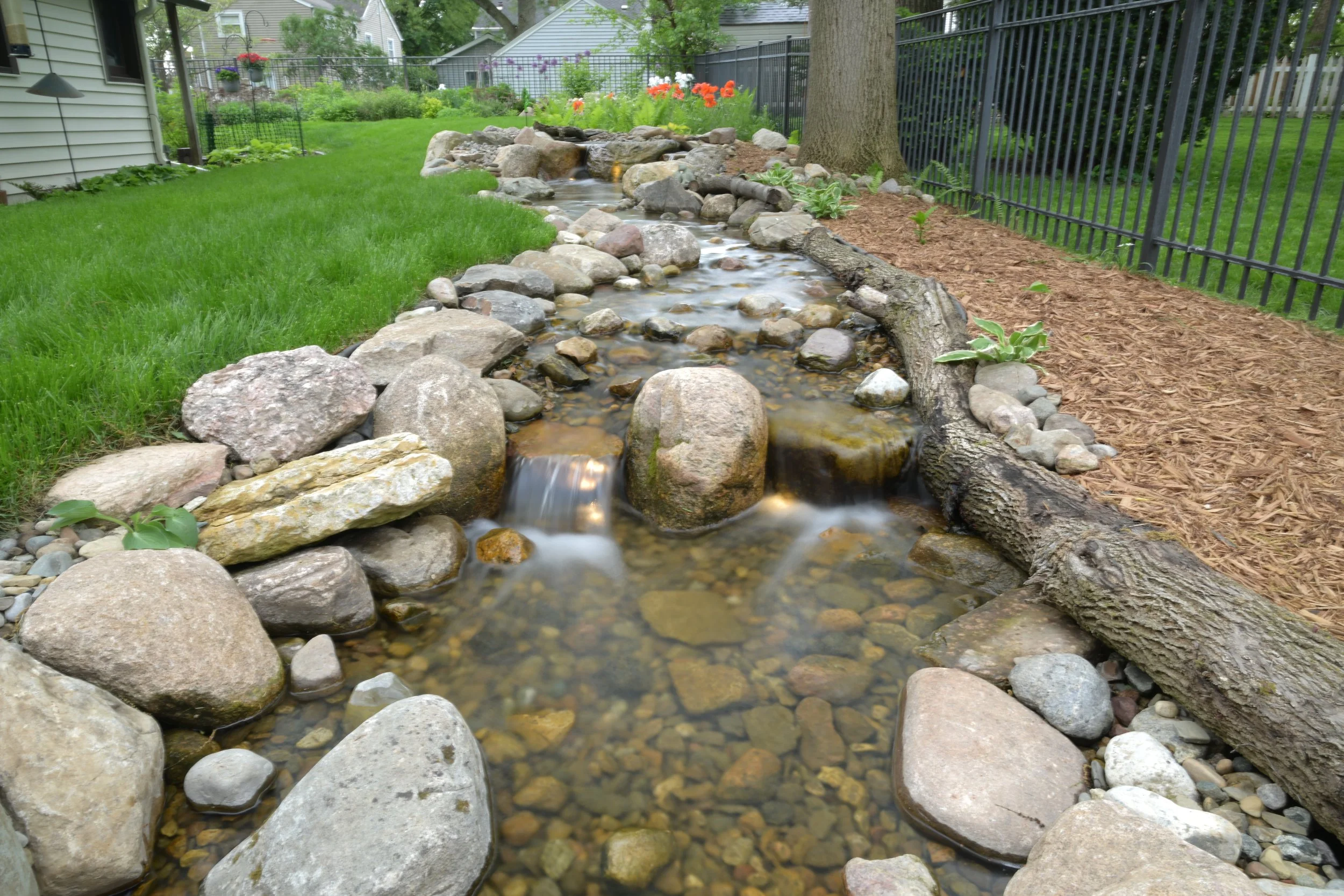
A backyard waterfall can completely change the way you experience your outdoor space. The sound of moving water, natural stone, and a stream winding through the landscape can turn an ordinary backyard into a place you actually want to spend time.
But if you're considering having a backyard waterfall professionally installed, one of your first questions is probably how much it will cost.
At Aquascapes of Michiana, professionally installed backyard waterfalls start at $6,275 for a small feature, $13,625 for a medium feature, and $19,925 for a large feature. These prices are for pond-free waterfalls, also called disappearing waterfalls, which circulate water through an underground reservoir rather than collecting it in an exposed pond.
The final cost depends on the size of the feature, natural stone selection, excavation, equipment, and surrounding landscaping.
For homeowners in Northern Indiana and the Michiana area, understanding these factors can help you decide what type of waterfall makes sense for your property and budget.
How Much Does a Professionally Installed Backyard Waterfall Cost?
At Aquascapes of Michiana, backyard waterfall installation starts at $6,275. Our standard starting prices are based on three general sizes, with larger and more customized projects priced according to their design.
The table below compares the starting prices and approximate dimensions of our pond-free waterfall installations.
| Waterfall Size | Starting Price | Dimensions |
|---|---|---|
| Small | $6,275* | 6 ft long, 12 in high |
| Medium | $13,625* | 12 ft long, 20 in high |
| Large | $19,925* | 18 ft long, 28 in high |
*Prices shown are starting prices for pond-free backyard waterfall installation by Aquascapes of Michiana. Final pricing depends on project design, site conditions, access, materials, and customization. Contact us for a project-specific estimate.
Small Backyard Waterfall: Starting at $6,275
Our small backyard waterfalls are approximately 6 feet long with a 12-inch height.
This size works well in compact backyards, garden beds, and areas near patios or porches. A small waterfall can provide the relaxing sound of running water without taking up a large amount of space.
It's a good option for homeowners who want a natural-looking water feature close to an outdoor seating area.
Medium Backyard Waterfall: Starting at $13,625
Our medium backyard waterfalls are approximately 12 feet long with a 20-inch height.
This size allows for a longer stream, more natural stonework, and additional opportunities for cascading water.
A medium waterfall can become a noticeable part of the landscape while still fitting comfortably into many residential backyards.
Large Backyard Waterfall: Starting at $19,925
Our large backyard waterfalls are approximately 18 feet long with a 28-inch height.
These larger features provide more room for multiple cascades, substantial boulders, and a winding stream that creates the appearance of a natural waterway.
A large backyard waterfall can become the main focal point of an outdoor living area, particularly when incorporated into surrounding landscaping, patios, or garden spaces.
These prices are starting points. Final costs depend on property conditions, materials, design complexity, and customization.
What Is a Pond-Free or Disappearing Waterfall?
A pond-free waterfall, sometimes called a disappearing waterfall, is a recirculating water feature that creates the appearance and sound of a natural stream or waterfall without an exposed pond at the bottom.
Instead of collecting in an open pool, the water flows into a bed of decorative gravel and stone. Beneath the surface is an underground reservoir that stores the water before a pump circulates it back to the top.
This creates a continuous flow of water through the feature.
Pond-free waterfalls are popular with homeowners who love the look and sound of moving water but don't necessarily want a koi pond or the responsibilities associated with keeping fish.
They can be designed as compact waterfalls beside a patio, longer streams winding through a landscape, or larger features with multiple cascades and natural boulders.
What Factors Affect Backyard Waterfall Installation Costs?
Two backyard waterfalls may look similar in photographs but have very different installation costs.
The difference often comes down to the materials, equipment, site conditions, and amount of work required to create the finished feature.
1. Waterfall Size and Length
The overall dimensions of a backyard waterfall are among the biggest factors affecting cost.
A compact waterfall tucked into a planting bed requires less excavation, liner, plumbing, and stone than a long stream running across a backyard.
Larger features also generally require more water circulation and reservoir capacity.
However, length alone doesn't determine the price. A short waterfall built with massive boulders or complex elevation changes may require more labor and equipment than a longer, simpler stream.
2. Number and Size of Waterfalls
Some homeowners prefer a single, gentle waterfall that creates a soft sound near a seating area.
Others want several cascading waterfalls connected by a winding stream.
Additional waterfalls can involve more detailed rock placement, liner work, and water-flow adjustments.
The size and shape of the individual drops also influence how the feature is constructed.
A broad, natural-looking waterfall requires careful stone selection and placement to achieve the intended appearance and sound.
3. Natural Stone and Boulder Selection
Natural stone is one of the most visually important parts of a backyard waterfall.
Larger boulders can make a waterfall feel like it has always been part of the landscape. Smaller accent stones and gravel help create transitions and define the stream.
Stone selection affects both material costs and installation labor.
Large boulders may require specialized equipment to transport, position, and stabilize.
The goal is to create a natural-looking feature with properly supported rockwork and a consistent flow of water.
4. Underground Reservoir Size
For pond-free waterfalls, one of the most important components is the part you don't see.
The underground reservoir holds the water needed to operate the system.
Its capacity must account for the water circulating through the stream and waterfalls, as well as the water that drains back when the pump shuts off.
A larger waterfall or longer stream may require a larger reservoir.
An undersized reservoir can lead to operational problems, so proper reservoir sizing is an important part of the overall design.
5. Pump and Plumbing Requirements
The pump needs to provide enough water flow to create the desired appearance while overcoming the elevation and plumbing resistance within the system.
A narrow stream with a gentle cascade has different requirements than a wide waterfall designed for a substantial volume of water.
The pump, plumbing diameter, and overall system design should work together.
A properly planned system also considers equipment access and ongoing maintenance.
6. Property Access and Excavation
Every backyard is different.
Some properties have easy access for excavation equipment and stone delivery. Others have narrow gates, steep slopes, existing landscaping, or limited space to move materials.
Site conditions can affect how much labor and equipment are needed.
The amount of excavation, grading, and preparation required also contributes to the installation cost.
7. Landscaping and Finishing Details
A backyard waterfall can be installed as a standalone feature, but many homeowners want it to feel like part of a complete outdoor space.
Surrounding details might include natural stone pathways, planting beds, landscape lighting, or a nearby patio.
These elements can make the waterfall feel more established and intentional.
They also affect the overall project budget.
Small Backyard Waterfall vs. Large Custom Waterfall
Not every backyard needs an elaborate water feature.
A smaller backyard waterfall can be a great option for a courtyard, patio, garden bed, or compact backyard.
These features typically focus on a short stream or one primary waterfall.
A larger custom waterfall may include several cascades, a winding stream, substantial natural boulders, and detailed transitions into the surrounding landscape.
Both can be beautiful when designed for their setting.
The best choice depends on how you plan to enjoy the feature.
If you want to hear moving water while sitting on your patio, placement and sound may be more important than overall size.
If you want the waterfall to become the main focal point of your backyard, a larger feature may be worth considering.
Are Backyard Waterfalls Less Expensive Than Koi Ponds?
Pond-free backyard waterfalls are often less expensive than comparably sized koi pond projects because they don't require an open pond designed to support fish.
A koi pond may need additional excavation, filtration equipment, circulation components, and other construction details related to maintaining an aquatic ecosystem.
A disappearing waterfall uses a recirculating system without an exposed fish pond.
However, that doesn't mean every backyard waterfall will cost less than every koi pond.
A large, elaborate waterfall with extensive stonework can cost more than a modest koi pond.
If you're comparing the two, think about how you want to use your backyard.
A koi pond offers the experience of keeping fish and enjoying an aquatic ecosystem. A pond-free waterfall focuses on the appearance and sound of flowing water.
You can learn more about our koi pond installation services if you're considering both options.
How Much Does a Backyard Waterfall Cost to Maintain?
Pond-free backyard waterfalls are generally considered lower-maintenance water features because they don't have an exposed pond supporting fish.
However, they are not maintenance-free.
Leaves, sediment, and other debris can collect in the stream and gravel areas. Pumps and intake areas also need occasional inspection and cleaning.
Water levels should be monitored, particularly during hot or windy weather when evaporation and splash loss can increase.
Some homeowners choose to add an automatic water-fill system to help maintain the reservoir level.
Routine care helps keep the waterfall looking good and operating properly.
The actual maintenance cost depends on the feature's size, surrounding landscape, pump, and how often professional service is needed.
Can You Add a Backyard Waterfall to an Existing Landscape?
Yes. A backyard waterfall can often be incorporated into an established outdoor space.
It may be placed along a garden bed, beside a patio, near an outdoor seating area, or within a sloped section of the property.
In some cases, existing elevation changes can become part of the design.
The contractor will need to evaluate available space, access, grading, and the intended location of the reservoir and equipment.
A waterfall should look like it belongs in the landscape rather than appearing as an isolated structure.
For many homeowners, the surrounding stonework and planting design are just as important as the waterfall itself.
Is a Backyard Waterfall Worth the Investment?
The value of a backyard waterfall is largely about how it changes the experience of your outdoor space.
A thoughtfully designed waterfall can create a relaxing place to sit, add movement to the landscape, and make a patio or garden more inviting.
It can also provide the sound of running water without the responsibilities associated with keeping fish.
Whether the investment is worthwhile depends on your priorities, budget, and how much time you spend enjoying your backyard.
For some homeowners, a small waterfall near their favorite seating area is enough.
Others want a larger, more immersive feature that becomes the centerpiece of their landscape.
How to Get an Accurate Backyard Waterfall Installation Estimate
The best way to understand the cost of your specific project is to discuss your ideas with an experienced water feature contractor.
Before requesting an estimate, consider a few details:
Where would you like the waterfall located?
Do you prefer a gentle stream or more dramatic waterfalls?
How large is the available space?
Do you have inspiration photos showing the style you like?
Will the project include surrounding landscaping, lighting, or hardscaping?
Do you have a budget range in mind?
Having this information ready can help the contractor recommend a design that makes sense for your property.
It's also helpful to ask what is included in the estimate, especially regarding the underground reservoir, pump, plumbing, rockwork, and site restoration.
Backyard Waterfall Installation in Northern Indiana
Aquascapes of Michiana designs and installs custom backyard waterfalls and other outdoor water features throughout Northern Indiana and the surrounding Michiana area.
Our projects are designed around each property's layout, the homeowner's preferences, and the way the finished feature will be enjoyed.
Whether you're envisioning a small waterfall beside your patio or a larger natural stream winding through the landscape, the goal is to create something that looks beautiful and functions reliably.
Explore our waterfall installation services to see what's possible.
Ready to discuss your backyard? Contact Aquascapes of Michiana to start planning your water feature.
Frequently Asked Questions
What is the average cost of a backyard waterfall?
At Aquascapes of Michiana, professionally installed pond-free backyard waterfalls start at $6,275 for a small 6-foot feature, $13,625 for a medium 12-foot feature, and $19,925 for a large 18-foot feature. These are starting prices rather than a market-wide average. Final pricing depends on the design, materials, site conditions, and customization.
Is a backyard waterfall cheaper than a koi pond?
Often, yes, when comparing projects of similar size and complexity. Pond-free waterfalls don't require an exposed fish pond, but large custom waterfalls with substantial stonework can still represent a significant investment.
Do backyard waterfalls use a lot of electricity?
Electricity usage depends on the pump's wattage and how long it operates. A contractor can help you understand the pump requirements and estimate operating costs for your particular design.
Can a backyard waterfall run all year in Indiana?
Some pond-free waterfalls can operate during cold weather, but freezing temperatures create additional considerations, including ice formation, water loss, and equipment protection. Whether to operate through winter depends on the feature's design and conditions.
How long does it take to install a backyard waterfall?
Installation time depends on the project's size, access, excavation requirements, stonework, and weather. A compact feature may take considerably less time than a large custom stream with multiple waterfalls and extensive landscaping.