
Do You Need to Test Your Pond Water? What the Results Actually Mean
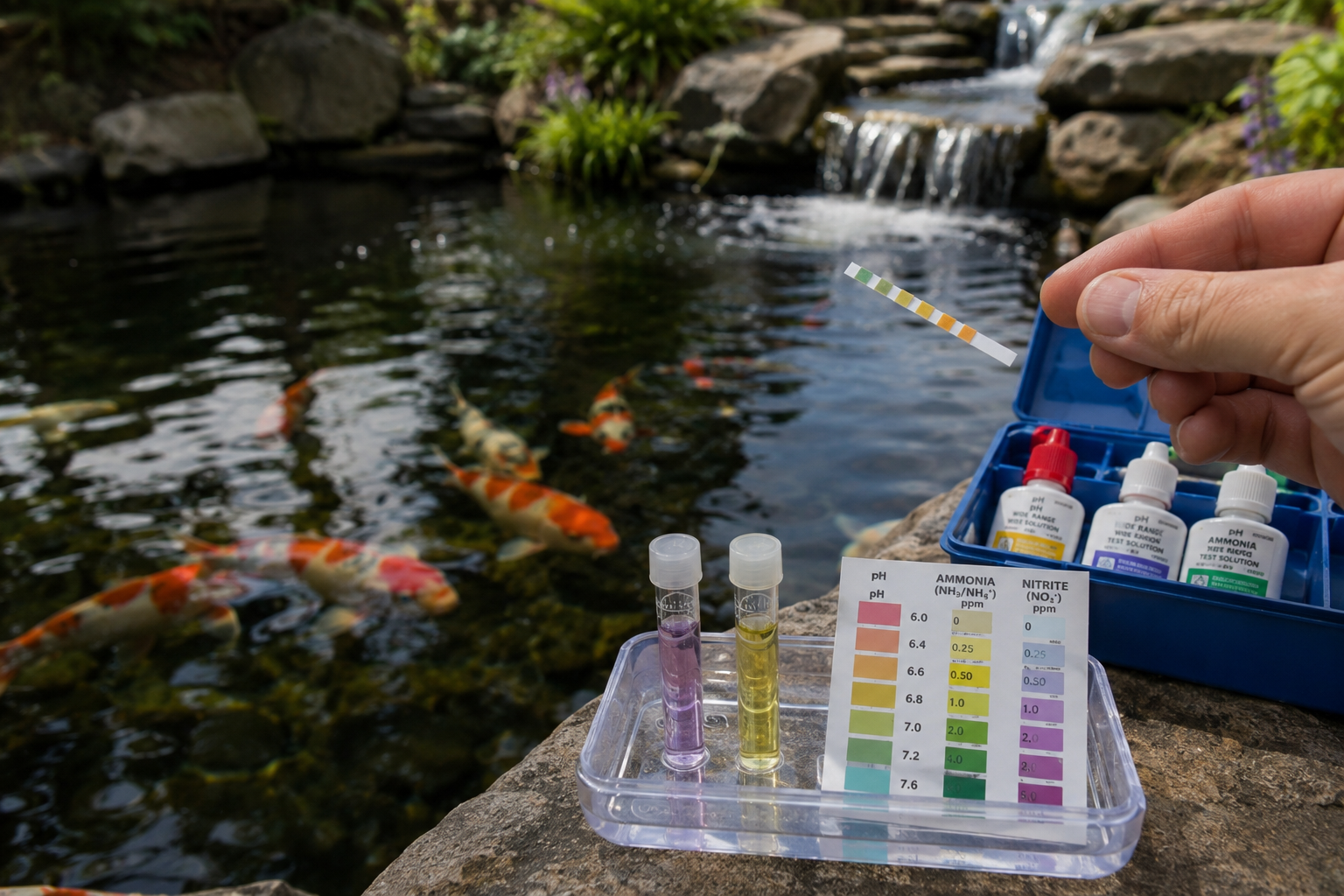
If you've spent any time researching pond care, you've probably been told the same thing over and over:
"Buy a water test kit."
Walk into almost any pet store or garden center, and you'll find shelves lined with test strips, liquid test kits, and digital meters promising to help you maintain the perfect pond. It can leave homeowners with the impression that owning a pond means constantly checking water chemistry, adjusting pH, and chasing numbers every weekend.
The truth is a little more complicated.
Water testing is absolutely a valuable tool. In the right situation, it can help identify problems before they become serious and point you toward the cause of poor water quality. But if you own a properly designed ecosystem pond that's functioning the way it should, testing your water shouldn't become part of your weekly routine.
In fact, if you're constantly reaching for a test kit, it may be a sign that something else needs attention.
A Healthy Pond Isn't Supposed to Be High Maintenance
One of the biggest misconceptions about backyard ponds is that they're similar to aquariums.
They're not.
An aquarium is a closed system with a relatively small amount of water. Fish are living in a confined space, plants are often limited, and there's very little room for nature to help maintain balance. That's why aquarium owners regularly monitor water chemistry and perform scheduled water changes.
A professionally built ecosystem pond works differently.
Instead of relying on chemicals and constant adjustments, it uses natural biological processes to keep the water healthy. Beneficial bacteria break down waste. Aquatic plants absorb excess nutrients. Proper circulation keeps oxygen moving throughout the pond, while a correctly sized filtration system removes debris before it becomes a larger problem.
All of these components work together to create balance.
That's the goal from the very beginning.
Rather than building a pond that requires constant attention, we want to build one that allows homeowners to spend more time enjoying the water than managing it.
What Makes an Ecosystem Pond Different?
Think about your favorite lake or creek.
Nobody walks out every Saturday morning to test the water before the fish start swimming.
Nature has a remarkable ability to maintain balance when the ecosystem is healthy.
While a backyard pond is much smaller than a natural lake, the same principles apply.
A healthy ecosystem pond combines several important pieces that support one another:
Mechanical filtration removes leaves and larger debris before they break down.
Biological filtration provides a home for beneficial bacteria that convert harmful fish waste into less harmful compounds.
Water circulation keeps oxygen levels up while preventing stagnant areas.
Aquatic plants compete with algae for nutrients and naturally improve water quality.
Proper pond depth helps maintain more consistent water temperatures throughout the year.
No single component does all the work.
It's the combination of these elements that creates a healthy environment for fish, plants, and beneficial microorganisms.
When one piece is missing or undersized, that's when problems usually begin.
Your Pond Will Usually Tell You Something Is Wrong
One of the first questions we ask homeowners isn't,
"What did your water test say?"
It's,
"What has changed?"
Sometimes the answer is obvious.
"The waterfall isn't flowing like it used to."
"The fish aren't coming up to eat."
"The water suddenly turned cloudy."
"We've started seeing string algae everywhere."
Those observations often tell us more than a strip of colored paper ever could.
Your pond is constantly giving you clues.
Healthy koi are active and curious. They should eagerly swim toward you at feeding time. Water should have movement across the surface, and your waterfall should sound the same as it always has. Plants should be growing normally during the season, and the pond shouldn't develop unpleasant odors.
When those things begin changing, it's worth paying attention.
That doesn't necessarily mean the water chemistry is out of balance, but it does tell you something in the ecosystem has changed.
Don't Chase Numbers
One of the biggest mistakes we see is homeowners trying to achieve "perfect" water parameters.
It's understandable.
You test your water, compare the results to a chart, and immediately notice one value that's slightly outside the recommended range. Before long, you're researching products designed to lower this, raise that, or stabilize something else.
The problem is that ponds don't exist in perfect laboratory conditions.
A healthy pond is constantly changing.
Rainfall can influence water chemistry. Hot summer temperatures increase biological activity. Fish grow. Plants mature. Leaves fall into the water during autumn. Beneficial bacteria populations fluctuate throughout the year.
Some variation is completely normal.
In many cases, fish are far more sensitive to sudden swings than they are to numbers that remain consistently a little higher or lower than the "ideal."
For example, a pond with a stable pH of 8.0 is often healthier than one bouncing between 7.0 and 8.0 every few days because someone is constantly trying to adjust it.
Stability matters more than perfection.
Water Testing Is a Tool, Not a Routine
Think of a water test the same way you'd think about a thermometer.
You probably don't check your temperature every morning just because you own one.
But if you suddenly feel sick, it becomes incredibly useful.
Pond water testing works much the same way.
It's one of the best diagnostic tools available when something appears wrong.
It helps confirm or eliminate possible causes, allowing you to make informed decisions instead of guessing.
What it shouldn't become is a weekly habit driven by the fear that something might be wrong even when your pond is thriving.
A healthy ecosystem pond should spend most of its time taking care of itself.
That's exactly what it was designed to do.
So Why Are Water Test Kits Everywhere?
It's a fair question.
If healthy ponds don't require constant testing, why are test kits so heavily promoted?
Part of the answer is that they're genuinely useful products.
Another reason is that much of the advice you'll find online comes from the aquarium world, where regular testing is essential because of the limited water volume and closed environment.
Those recommendations often get carried over to backyard ponds without considering the differences between the two.
There's also a tendency to assume that more information always leads to better pond care.
But numbers without context can actually create more confusion.
A homeowner might see slightly elevated nitrate levels and immediately think something is wrong, even though the fish are healthy, the plants are thriving, and the pond has been functioning beautifully for years.
Understanding what those numbers actually mean is far more valuable than simply collecting them.
And that's where water testing becomes truly useful.
Not because it tells you everything about your pond...
...but because it helps answer the right questions when your pond tells you something has changed.
What Your Pond Water Test Is Actually Telling You
This is where many pond owners get overwhelmed.
You dip a test strip into the water or fill a few small tubes with pond water, compare the colors to the chart, and suddenly you're looking at terms like pH, KH, ammonia, and nitrite.
If you've never heard those words before, it's easy to assume every number has to be perfect.
It doesn't.
More importantly, every test result should be viewed as part of the bigger picture. Looking at one number by itself rarely tells the whole story.
Let's break down what each parameter actually means and why it matters.
pH: Don't Obsess Over It
The first thing most people look at is pH.
pH measures whether your water is acidic or alkaline. On paper, it's one of the easiest tests to understand.
It's also one of the easiest to misunderstand.
Many homeowners think there is one perfect pH for every pond.
There isn't.
Healthy koi and pond fish can live comfortably within a fairly broad pH range as long as that range stays consistent. Problems usually happen when pH changes rapidly, not because it's naturally a little higher or lower than someone else's pond.
That's why we rarely recommend chasing pH with chemicals.
If your fish are healthy, your filtration is working properly, and the pond has been stable for months, changing the pH simply because it isn't sitting exactly where you think it should can actually create more stress than leaving it alone.
Ammonia: The One Number That Gets Our Attention
If there's one test result we don't ignore, it's ammonia.
Fish naturally produce waste, and as that waste breaks down, ammonia is released into the water.
Even small amounts can become harmful.
Fortunately, healthy ecosystem ponds have an army working around the clock to deal with it.
Beneficial bacteria living inside your biological filter convert ammonia into nitrite, which is then converted again into nitrate.
This process is called the nitrogen cycle, and it's one of the most important biological functions happening inside your pond every single day.
If ammonia begins showing up on a water test, it usually tells us something bigger is going on.
Maybe the biological filter hasn't matured yet.
Maybe the pump stopped circulating water.
Perhaps too many fish were added at once.
Or maybe the filtration system simply isn't large enough for the pond.
The ammonia itself isn't usually the root problem.
It's the symptom.
Nitrite: A Sign the System Isn't Finished Yet
Nitrite is the middle step in the nitrogen cycle.
It's less toxic than ammonia but still dangerous if it builds up.
Most established ponds shouldn't have measurable nitrite levels for very long.
When we see nitrite, it's often because the biological filter is still developing or recovering from a disruption.
For example:
A brand-new pond that's only been running a few weeks.
A filter that was cleaned too aggressively.
A pump that stopped running for several days.
Heavy use of medications that affected beneficial bacteria.
In many cases, the answer isn't adding another chemical.
It's allowing the biological filter time to recover while maintaining proper circulation and oxygen levels.
Nitrate: Not Always a Problem
By the time ammonia has been converted into nitrate, you've reached the final stage of the nitrogen cycle.
Unlike ammonia and nitrite, nitrate isn't usually an emergency.
In fact, it's expected.
Plants actually use nitrate as food.
That's one reason aquatic plants are such an important part of a healthy ecosystem pond. They naturally remove nutrients that might otherwise contribute to algae growth.
If nitrate begins climbing unusually high, it may indicate that your pond has more nutrients than your plants and filtration can keep up with.
Again, the number itself isn't the diagnosis.
It's simply another clue.
KH: The Test Most Homeowners Have Never Heard Of
If there's one water parameter that deserves more attention, it's KH.
KH stands for carbonate hardness.
Think of it as your pond's buffering capacity.
Beneficial bacteria consume carbonates as they break down fish waste. Without enough KH, those bacteria begin struggling, biological filtration slows down, and pH can become unstable.
That's why we often pay closer attention to KH than pH itself.
A pond with a healthy KH usually experiences fewer dramatic swings because it has the resources needed to support the biological filter.
Most homeowners have never heard of KH until something goes wrong.
Once you understand its role, it starts making much more sense why stable ponds stay stable.
GH: Important, But Usually Not the First Place We Look
Another test you may see is GH, or general hardness.
GH measures dissolved minerals such as calcium and magnesium.
These minerals contribute to overall fish health and support plant growth, but GH usually changes very slowly over time.
Unless your water source is unusually soft or unusually hard, GH isn't something most established pond owners need to monitor constantly.
It's another piece of the puzzle rather than the whole picture.
What About Oxygen?
One thing you'll notice is that most basic pond test kits don't measure dissolved oxygen.
Ironically, it's one of the most important factors affecting fish health.
Good circulation, waterfalls, streams, and properly functioning pumps naturally introduce oxygen into the water.
That's one reason pump failures often become emergencies, especially during the heat of summer.
When water stops moving, oxygen levels can begin dropping long before a water test reveals any chemical imbalance.
Sometimes the simplest observation tells you everything you need to know.
Is the waterfall still running?
Water Tests Don't Tell You Why
This might be the most important thing to remember.
A test kit gives you information.
It doesn't diagnose the problem.
Let's say ammonia suddenly appears in your pond.
The test kit tells you ammonia is present.
It doesn't tell you whether the cause is:
An undersized filter.
Too many fish.
A pump failure.
Decaying organic debris.
A biological filter that hasn't matured.
A recent medication treatment.
Something else entirely.
That's where experience comes in.
Looking at the pond as a complete ecosystem often reveals the real issue much faster than focusing on one number alone.
The healthiest ponds aren't maintained by constantly reacting to water test results.
They're maintained by understanding how every part of the ecosystem works together.
When Should You Test Your Pond Water?
By now, you might be wondering if we're saying you should throw your water test kit away.
Not at all.
There are times when testing your pond water is one of the smartest things you can do. The difference is why you're testing.
Instead of making it part of a weekly routine, think of it as a diagnostic tool you use when your pond tells you something has changed.
Here are a few situations where water testing makes sense.
Your Pond Is Brand New
Every new pond goes through what many hobbyists call the "new pond syndrome."
Even if the pond has excellent filtration, the beneficial bacteria that process fish waste need time to establish themselves. During those first several weeks, it's normal for the ecosystem to be finding its balance.
If you've recently built a pond or completed a major renovation, occasional testing can help you monitor how that biological filter is developing.
You've Added a Lot of New Fish
Every fish you add increases the biological load on the pond.
A few new koi usually aren't a problem in an established ecosystem, but adding a large number of fish at one time can temporarily overwhelm the filtration until beneficial bacteria populations catch up.
Testing during this adjustment period can provide peace of mind while the pond rebalances itself.
Your Fish Are Acting Differently
Healthy koi are surprisingly good at letting you know when something isn't right.
If they're staying near the surface, hanging around the waterfall more than usual, refusing food, isolating themselves, or behaving unusually, don't ignore it.
Water quality may not be the problem, but it's one of the first things worth checking while you investigate.
After a Major Equipment Failure
If your pump stopped running overnight or your filtration system has been offline for several days, testing can help determine whether the interruption affected water quality.
Good circulation keeps oxygen moving through the pond and supports the beneficial bacteria living inside the filter. When circulation stops, the entire ecosystem feels the effects.
After a Chemical Spill or Contamination
Heavy fertilizer runoff, accidental chemical exposure, or other unexpected contaminants are another situation where testing becomes valuable.
Fortunately, these situations are uncommon, but when they happen, gathering information quickly can help determine the best course of action.
What We Don't Recommend
There are also situations where testing probably isn't necessary.
If your pond has been running well for years...
The water is clear...
The fish are active...
Your plants are thriving...
The waterfall is flowing properly...
...there usually isn't much value in testing the water simply because it's Saturday morning.
It's a little like taking your temperature every day when you feel perfectly healthy.
Owning the thermometer doesn't mean you need to use it constantly.
Build the Pond Correctly, and the Rest Gets Easier
One of the reasons ecosystem ponds have become so popular is that they're designed to work with nature instead of constantly fighting against it.
A properly built pond starts with adequate filtration.
Not just enough filtration to keep the water moving, but enough biological filtration to support the fish that will eventually live there.
It includes proper circulation so every part of the pond receives oxygen-rich water.
It incorporates beneficial bacteria that continuously break down waste.
Aquatic plants help absorb nutrients that would otherwise feed algae.
Rock and gravel provide additional surface area for biological activity.
Every component supports the others.
When that system is balanced, pond maintenance becomes much more predictable because the pond is doing much of the work on its own.
That's exactly what we aim for when designing ecosystem ponds throughout Northern Indiana.
Water Testing Won't Fix a Poorly Designed Pond
This may be the biggest takeaway from the entire article.
A test kit can tell you something is wrong.
It can't solve the reason it's wrong.
If a pond has inadequate filtration, poor circulation, too many fish, or years of built-up organic debris, no amount of testing will correct those underlying issues.
You may temporarily improve one number, only to watch another problem appear a few weeks later.
It's a frustrating cycle that many homeowners experience before realizing the issue isn't the water itself.
It's the system supporting it.
That's why we spend so much time focusing on proper construction, quality filtration, and long-term ecosystem balance instead of quick fixes.
Learn to Observe Your Pond
One of the best habits you can develop isn't testing your water.
It's paying attention.
Spend a few minutes simply watching your pond.
Notice how the fish behave.
Listen to the waterfall.
Watch how water moves across the surface.
Look at your aquatic plants.
Has anything changed since last week?
Most pond problems don't appear overnight.
They develop gradually, leaving small clues along the way.
Homeowners who regularly enjoy their ponds often notice those clues long before they become expensive repairs.
The Best Water Quality Test Happens Every Day
If your koi rush to greet you at feeding time...
If your waterfall sounds the way it always has...
If your water is clear enough to watch fish swim beneath the surface...
If your lilies are blooming and dragonflies are hovering overhead...
Your pond is probably doing exactly what it was designed to do.
That's not to say water chemistry doesn't matter.
It absolutely does.
But a healthy ecosystem often tells its story long before you ever reach for a test strip.
Final Thoughts
Water testing has an important place in pond ownership, but it isn't something most homeowners should feel obligated to do every weekend.
Think of it as a tool, not a routine.
When your pond is healthy, stable, and supported by the right filtration system, beneficial bacteria, aquatic plants, and proper circulation, nature does an incredible job of maintaining balance.
And when something does seem off, a water test can provide valuable information to help identify the cause.
The goal isn't to become an expert in water chemistry.
It's to own a pond that's enjoyable, beautiful, and healthy enough that you don't have to think about water chemistry very often at all.
That's the difference a properly designed ecosystem pond can make.
At Aquascapes of Michiana, we believe homeowners should spend their weekends relaxing beside their pond, not constantly chasing numbers on a test strip. Whether you're planning a new water feature or trying to solve ongoing water quality issues, building the right ecosystem from the start is almost always the best solution.
Frequently Asked Questions
Is it normal to test pond water every week?
For most established ecosystem ponds, no. If your pond has proper filtration, healthy fish, good circulation, and clear water, routine weekly testing usually isn't necessary. Water testing is most valuable when you're troubleshooting a specific problem or monitoring a new pond.
What's the most important pond water test?
If we had to choose one, it would often be ammonia, since elevated ammonia can quickly become harmful to fish. That said, no single test tells the whole story. It's important to evaluate your pond as an entire ecosystem rather than focusing on one number.
Are pond test strips accurate?
Test strips are a convenient way to identify general trends in water quality and are often sufficient for homeowners. Liquid test kits are typically more precise, but either can be helpful when used alongside careful observation of your pond.
Can clear pond water still have poor water quality?
Yes. Water can appear crystal clear while still containing elevated ammonia or other imbalances. That's one reason water testing can be useful when fish appear stressed, even if the pond looks healthy.
How do I improve my pond's water quality naturally?
The best long-term approach is creating a balanced ecosystem. Proper filtration, healthy populations of beneficial bacteria, aquatic plants, good circulation, and avoiding overstocking fish all work together to maintain naturally healthy water without relying on constant chemical treatments.