
How Landscaping Around Your Pond Makes All the Difference
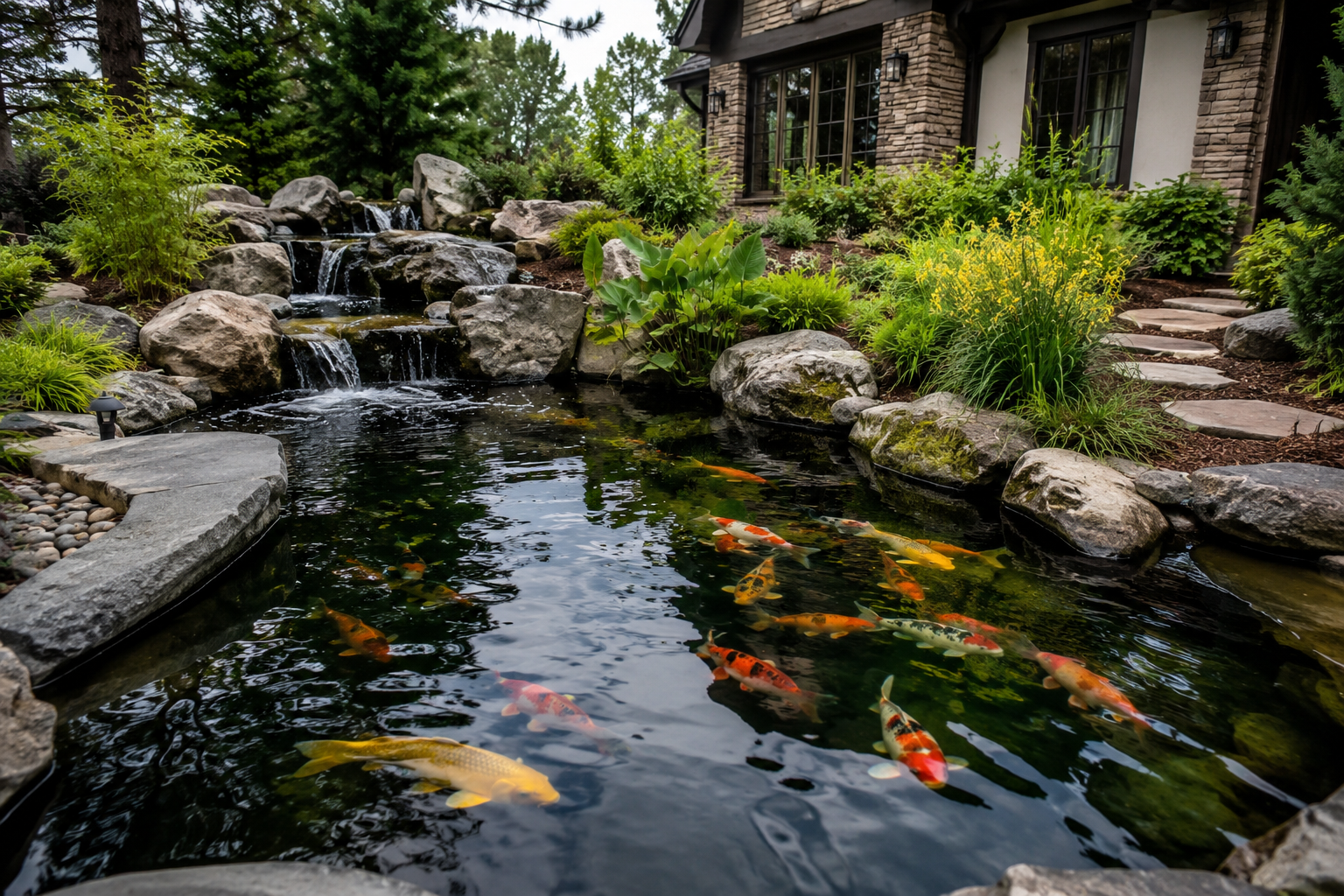
When most homeowners picture their dream pond, they imagine the waterfall, the sound of moving water, and maybe a few colorful koi swimming beneath the surface. What they don't usually picture is the landscaping around it.
Ironically, that's often the difference between a pond that looks like it was installed last week and one that looks like it has always belonged there.
We've all driven past water features that immediately catch our attention for the wrong reasons. The pond itself might be beautiful, but it's surrounded by nothing more than grass. Maybe there's a ring of mulch around the edge or a few shrubs planted in a perfect row. Instead of blending into the property, the pond feels separate from it.
Now think about your favorite nature trail.
Streams don't suddenly stop and transition into perfectly cut grass. Rocks vary in size. Ferns grow between boulders. Grasses spill over the edges. Trees provide shade while wildflowers fill open spaces. Every element works together, and because of that, nothing feels forced.
That's the feeling we try to recreate with every project we build.
A Pond Should Feel Like Part of the Landscape
One of the biggest compliments we receive isn't about the waterfall or the fish.
It's when someone says, "It looks like it's always been here."
That's the goal.
A well-designed pond shouldn't feel like an addition to your backyard. It should feel like the backyard was designed around the pond.
That doesn't happen by accident. It happens because every surrounding element is considered before the first plant ever goes into the ground.
Where will you view the pond from inside your home?
Where will people naturally gather when friends come over?
Which direction does the afternoon sun hit?
Will the landscaping still look attractive in January after the flowers disappear?
These are questions that influence the finished project just as much as the shape of the pond itself.
Landscaping Does More Than Make a Pond Beautiful
Most people think landscaping is simply decoration.
In reality, it's one of the hardest-working parts of the entire project.
The right landscaping helps soften the edges of the pond so it blends naturally into the yard. It reduces erosion around the shoreline, filters rainwater before it reaches the pond, provides shade during the hottest part of summer, and creates habitat for birds, butterflies, frogs, and other wildlife.
Even your fish benefit.
Plants around the pond help create a healthier ecosystem while making the entire area more enjoyable for you. Instead of walking out your back door and seeing "a pond," you step into a complete outdoor environment.
That's a big difference.
Start With the Big Picture
One mistake we occasionally see is homeowners planting one shrub here and another perennial there without an overall plan.
There's nothing wrong with buying plants you like. The problem is they often don't work together.
Imagine hanging pictures on a wall one at a time without considering how they'll look as a group. Each individual piece might be beautiful, but the finished wall can feel random.
Landscaping works the same way.
Before choosing a single plant, it's worth stepping back and asking yourself what you want the space to feel like.
Do you picture a quiet woodland retreat?
A colorful cottage garden?
A modern landscape with clean lines?
A natural-looking stream that appears to wind through the property?
Having a clear vision makes every decision afterward much easier.
Think About Every Season, Not Just Spring
Garden centers are full of color in April and May.
It's easy to fall in love with blooming flowers when everything looks its best.
The challenge comes six months later.
Professional pond landscapes are designed to be interesting every month of the year, not just during peak blooming season.
That means mixing different textures, heights, bloom times, and evergreen plants so something is always catching your eye.
In spring, maybe it's the fresh green leaves emerging around the waterfall.
Summer brings water lilies, ornamental grasses, and vibrant perennial flowers.
By fall, those same grasses begin to sway in the breeze while trees reflect brilliant colors across the pond's surface.
Even winter has its own kind of beauty. Snow resting on carefully placed boulders, ornamental grasses standing above the drifts, and an ice-covered waterfall can create one of the most peaceful scenes you'll experience all year.
When you plan for every season instead of one, the pond becomes a destination no matter what's on the calendar.
The Best Landscaping Doesn't Look Landscaped
This might sound strange coming from a pond contractor, but one of our goals is making it look like we weren't there.
Nature isn't symmetrical.
You don't find five identical shrubs planted exactly four feet apart beside a creek.
Rocks don't line up in perfect rows.
Plants don't all stop growing at the same height.
Instead, nature creates variation.
Some boulders dominate the landscape while others quietly support the scene. Taller grasses catch the wind behind shorter flowering plants. Groundcovers spill over rocks and soften hard edges. Nothing feels overly planned, even though there is tremendous intention behind it.
Ironically, creating something that looks effortless often takes the most planning.
Let the Pond Lead You Through the Yard
A pond shouldn't simply be something you look at from the patio.
It should invite you to explore.
Curving stone paths, stepping stones, small sitting areas, and carefully placed plants naturally encourage people to move around the water feature.
As you walk, your perspective changes.
A waterfall that looked hidden from one angle suddenly becomes the focal point.
A grouping of boulders frames the view from another.
The koi that were invisible a moment ago swim into sight beneath a patch of water lilies.
Those little discoveries make the landscape feel larger than it really is.
That's one reason professionally designed water features often seem much bigger than their actual footprint. The experience changes as you move through the space.
PART 2:
Choosing Plants That Will Still Look Great Five Years From Now
One of the easiest mistakes to make is buying plants based on how they look the day you bring them home.
We've all done it. You walk through the garden center, spot a beautiful flowering plant, and immediately picture it beside your waterfall. The tag says it grows two or three feet tall, so you think it'll fit perfectly.
Fast forward a few years, and that same plant has doubled in size, crowded out everything around it, and started hiding the waterfall you spent so much money to enjoy.
Good landscaping isn't just about today. It's about how everything will mature together.
That's why we encourage homeowners to think long term. A landscape should become more beautiful as it grows in, not become something you constantly have to cut back or redesign.
For Northern Indiana properties, that usually means choosing hardy perennials, ornamental grasses, shrubs, and aquatic plants that can handle our changing seasons without requiring constant attention.
The exact plant selection will vary depending on your property, but layering different textures almost always creates the most natural result.
Imagine broad hosta leaves tucked beneath ornamental grasses. Add flowering perennials in pockets of color, then soften the water's edge with creeping groundcovers and aquatic plants that blur the line between land and water.
Instead of individual plants competing for attention, the landscape begins to feel like one connected ecosystem.
Don't Underestimate the Power of Boulders
Plants may add color, but stone gives a pond its structure.
One of the first things we notice when looking at many DIY ponds is that every rock seems to be about the same size. While it might seem logical to buy a pallet of matching stones, nature doesn't work that way.
Visit almost any creek or river in Indiana and you'll notice enormous boulders mixed with medium-sized rocks, gravel, and everything in between.
That variety is what makes natural waterways feel...well...natural.
Large character boulders anchor the landscape. They become visual stopping points that draw your eye without demanding all the attention.
Smaller stones fill gaps, support planting pockets, and help transition from the pond into surrounding garden beds.
Equally important is how those rocks are placed.
A common mistake is setting every boulder directly on top of the ground where it looks like it could roll away with the next rainstorm.
In nature, rocks settle over time.
Professionally installed boulders are often partially buried so they appear rooted in the landscape rather than simply placed there. It's a subtle detail, but it's one people notice without realizing why.
Hiding the "Man-Made" Parts
Every pond has functional components.
Skimmers collect debris.
BioFalls house filtration.
Plumbing keeps water moving.
Those pieces are essential, but they don't need to be the first thing people notice.
Thoughtful landscaping helps disguise these elements without making them difficult to access when maintenance is needed.
A carefully placed shrub may soften the side of a filter while still allowing the lid to open. Ornamental grasses can hide plumbing without interfering with equipment. Groundcovers spill naturally over edges while leaving enough room to work around the pond when necessary.
The goal isn't to hide everything completely.
It's to let your eyes settle on the waterfall, the fish, and the surrounding landscape instead of the mechanics that make it all work.
The Water's Edge Deserves Extra Attention
If there's one place where landscaping can make or break a pond, it's the shoreline.
This transition between land and water should feel effortless.
Unfortunately, it's also where many ponds begin to look artificial.
A straight border of decorative rock around the entire perimeter creates a defined outline that immediately tells your brain someone built it.
Nature rarely creates perfect borders.
Instead, allow plants to soften the edge. Let certain areas feel lush while others expose more stone. Vary the size of rocks. Tuck small pockets of gravel between larger boulders.
Aquatic plants are especially valuable here because they help erase the line between the pond and the surrounding landscape.
As they mature, they create a gradual transition that makes the water feel like it's always belonged there.
Landscape Lighting Changes Everything
Many homeowners are surprised by how often they use their pond after dark.
During the day, the sunlight creates movement across the water.
At night, lighting creates an entirely different atmosphere.
A softly illuminated waterfall becomes the focal point of the backyard. Reflections shimmer across the pond's surface. Pathways become safer to navigate, and subtle lighting beneath nearby trees adds depth without overwhelming the landscape.
The key is restraint.
Brighter isn't always better.
Instead of trying to light every square foot, focus on highlighting features you naturally want people to notice. A waterfall, specimen tree, seating area, or large boulder often provides all the visual interest you need.
Done well, landscape lighting feels almost invisible. You notice the beauty of the space rather than the fixtures themselves.
Design the View From Inside Your Home
Here's something many homeowners don't think about until after a project is finished.
Where will you see your pond most often?
For many families, the answer isn't from the patio.
It's from the kitchen window while making dinner.
From the living room couch.
From the breakfast table with a cup of coffee.
Those everyday views matter just as much as the ones you experience outside.
That's why we often think about sightlines before placing major landscape elements.
A flowering tree may frame the waterfall from one window without blocking it from another. Taller grasses might create privacy from the neighbors while still leaving open views toward the pond.
When every angle is considered, the landscape continues working even when you're inside the house.
Creating Spaces You'll Actually Use
A pond is meant to be enjoyed, not admired from twenty feet away.
Think about where you'll spend time.
Do you picture reading beside the water on a quiet Saturday morning?
Watching your grandchildren feed the koi?
Hosting friends around a fire pit while the waterfall runs in the background?
Those activities influence how the surrounding landscape should be designed.
Adding a small patio, a winding path, a bench beneath a shade tree, or even a few carefully placed stepping stones encourages people to slow down and stay awhile.
Some of our favorite projects aren't necessarily the biggest ones.
They're the ones where the homeowners tell us, "We spend more time outside now than we ever did before."
That's the real goal.
The pond becomes more than a landscape feature.
It becomes part of everyday life.
A Landscape That Continues to Grow
One of the most rewarding parts of building ponds is knowing they won't look exactly the same a year from now.
In the best possible way.
Plants become fuller.
Groundcovers spread across stone.
Water lilies multiply.
Trees provide more shade.
Birds discover the space.
The landscape slowly develops its own personality.
That's something you simply can't buy on installation day.
It happens over time, and it's one of the reasons professionally designed ponds become more beautiful with age rather than less.
Like any great garden, the landscape continues telling its story long after construction is complete.
Common Pond Landscaping Mistakes Homeowners Make
Landscaping doesn't have to be complicated to be successful, but there are a few mistakes we see time and time again. The good news is that most of them are completely avoidable with a little planning.
One of the biggest is planting everything too close together.
It's understandable. A newly finished landscape can feel a little sparse, and there's a temptation to fill every empty space with another shrub or perennial. The problem is that plants grow. What looks perfectly spaced on installation day may become overcrowded just a few years later.
Giving plants room to mature might make the landscape look slightly more open at first, but patience pays off. Before long, they'll fill in naturally without competing for sunlight or airflow.
Another common mistake is choosing plants based solely on flowers.
Color certainly has its place, but a landscape that relies only on blooms often feels flat once those flowers fade. Mixing different leaf shapes, shades of green, ornamental grasses, and evergreen plants creates interest long after flowering season has ended.
We also encourage homeowners to think carefully before planting large trees right next to the pond.
While the shade can be beneficial, trees that constantly drop leaves, seed pods, or needles into the water create extra maintenance. As the roots mature, they can also begin competing with nearby plants and make future renovations more challenging.
Sometimes the best tree isn't the one closest to the water. It's the one positioned a little farther away, where it still frames the pond without creating unnecessary work.
Less Can Often Be More
When people start planning their landscaping, it's easy to feel like every square foot needs something in it.
More flowers.
More shrubs.
More decorative stone.
More garden art.
Ironically, some of the most peaceful landscapes are also the simplest.
Giving your eye places to rest allows the focal points to stand out. A quiet patch of ornamental grass can make a nearby waterfall feel even more dramatic. An open section of lawn can provide a visual break before leading you back toward the pond.
Not every corner needs to demand attention.
Sometimes the empty spaces are just as important as the planted ones.
Think Beyond the Pond Itself
One of our favorite questions to ask homeowners during the design process is simple:
"What do you want to do out here?"
The answer is almost never, "Look at the pond."
Instead, we hear things like:
"We want to drink coffee outside in the mornings."
"We'd love a place for the grandkids to explore."
"We want to entertain friends."
"We've always wanted somewhere to unwind after work."
Those answers shape the entire landscape.
Maybe that means adding a flagstone patio close enough to hear the waterfall.
Maybe it's a winding path that invites guests to walk around the pond instead of viewing it from one direction.
Maybe it's landscape lighting that allows the family to enjoy the space after the sun goes down.
The pond becomes the centerpiece, but the landscaping is what turns it into an outdoor living space.
A Beautiful Landscape Can Add Value Beyond Curb Appeal
While most homeowners build a pond because they want to enjoy it themselves, it's worth remembering that thoughtful landscaping can also increase the overall appeal of your property.
A professionally designed water feature surrounded by mature landscaping creates a sense of permanence. It looks intentional. Well cared for. Established.
Even if you have no plans to move, it's an investment you'll appreciate every single day.
Unlike many home improvements that are only used occasionally, a pond becomes part of your daily routine.
You see it through the kitchen window while making breakfast.
You hear the waterfall while grilling dinner.
You watch birds stop for a drink on quiet summer evenings.
You notice the changing seasons reflected in the water.
Those moments are difficult to put a price on.
Why Professional Design Makes Such a Difference
There are countless beautiful plants available at local nurseries.
There are also plenty of online photos filled with landscaping inspiration.
The challenge isn't finding ideas.
It's knowing how they'll all work together five or ten years from now.
Professional pond design isn't about choosing prettier plants. It's about understanding how every element interacts.
How much sunlight will this area receive in July?
Will this ornamental grass eventually block the waterfall?
How will runoff move during a heavy rain?
Will this shrub leave enough room to access the skimmer?
Can someone still comfortably walk around the pond once everything matures?
Those are questions that are easy to overlook until they become problems.
A well-designed landscape anticipates those challenges before the first shovel ever touches the ground.
Every Backyard Has a Story to Tell
No two properties are exactly alike.
Some backyards are wide open and full of sun. Others are tucked beneath mature trees with dappled shade throughout the day.
Some families want a quiet retreat where they can escape after work. Others picture birthday parties, cookouts, and grandchildren chasing frogs along the water's edge.
That's why the best landscapes are never copied from another project.
They take inspiration from nature, but they're ultimately designed around the people who will enjoy them every day.
When the landscaping reflects both the home and the family, it doesn't just look beautiful.
It feels personal.
Bringing It All Together
A pond is much more than water, rocks, and a waterfall.
It's the centerpiece of an outdoor environment.
The landscaping surrounding it determines whether the finished project feels disconnected from the yard or seamlessly woven into it. The right combination of plants, natural stone, lighting, and gathering spaces creates depth, movement, and interest throughout every season. It also supports a healthier ecosystem, attracts wildlife, and gives you more reasons to spend time outside.
Years from now, most visitors won't remember the exact size of the pond or how tall the waterfall is.
What they'll remember is how the space made them feel.
Peaceful.
Relaxed.
Connected to nature.
That's the difference thoughtful landscaping makes.
If you're planning a new pond or looking to breathe new life into an existing one, don't stop at the water's edge. Thoughtful landscaping is what transforms a beautiful pond into a backyard destination. The team at Aquascapes of Michiana designs complete outdoor environments that look natural from day one and continue to grow more beautiful with every season.
Whether you're dreaming of a colorful koi pond, a peaceful waterfall, or a complete backyard retreat, we'd love to help you create a landscape that feels like it has always belonged there.